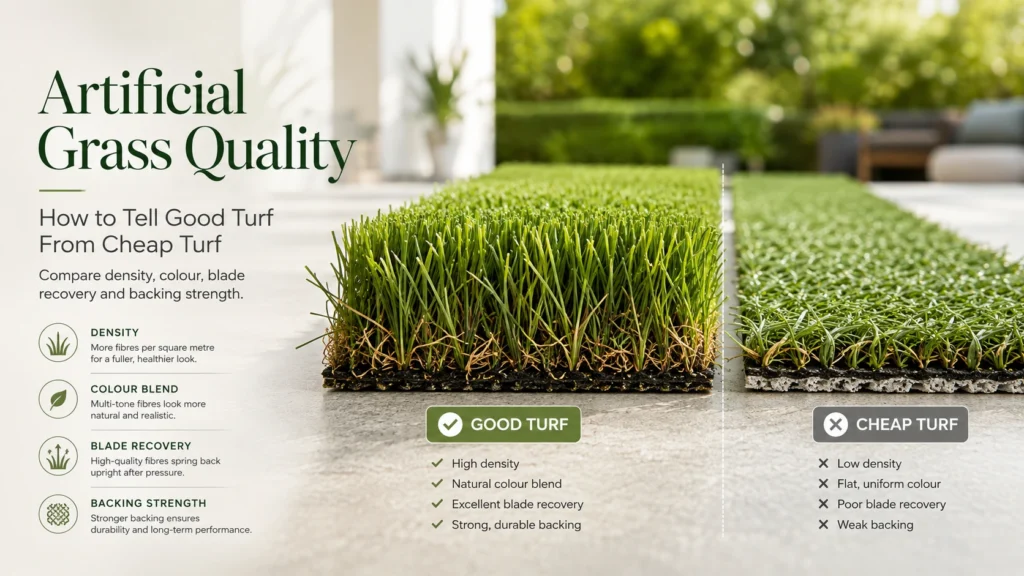
Two artificial grass samples can look almost identical when they are new, yet perform very differently after months of foot traffic, heat, rain and outdoor exposure.
Artificial grass quality cannot be judged by softness, price or pile height alone. A reliable turf system combines resilient fibres, appropriate density, stable backing, secure tufting, UV protection, drainage and correct installation.
The most useful way to compare products is to inspect them physically and ask for the specifications behind what you can see.
This guide explains exactly what to check so you can distinguish well-constructed turf from low-spec alternatives before choosing synthetic grass for your Sydney property.
What Makes Artificial Grass Good Quality?
Good artificial grass combines several components that work together rather than relying on one impressive specification.
High-quality artificial grass generally has resilient fibres suited to its intended use, consistent density, stable backing, secure tuft retention, effective drainage and documented UV stability.
Pile height also matters, but the correct height depends on the application. A family backyard, putting green, playground and commercial area require different surface characteristics.
Manufacturing standards and installation quality also influence how the turf performs once installed.
A taller, softer or heavier-looking product is not automatically better. The better product is the one whose fibre construction, backing, density and supporting system suit the traffic and conditions it will experience.
Good vs Cheap Artificial Grass at a Glance
The differences between good and low-spec turf often become clearer when you look beyond surface appearance.
| Feature | Good Quality Turf | Cheap/Low-Spec Turf Warning Signs |
| Fibres | Resilient and suited to use | Thin or flatten easily |
| Density | Consistent and adequately dense | Sparse construction |
| Colour | Natural tonal variation | Flat or artificial appearance |
| Backing | Stable and consistent | Lightweight or inconsistent |
| Tuft retention | Fibres held securely | Fibres release unusually easily |
| UV protection | Designed for outdoor exposure | Unclear or poorly documented |
| Drainage | Designed into the turf system | Limited or poorly specified |
| Warranty | Clear terms and exclusions | Vague or minimal |
| Specification | Transparent | Difficult to verify |
These are warning signs rather than absolute rules. Not every cheap artificial grass product displays every weakness listed above, and a higher-priced product is not automatically superior.
The Artificial Grass Quality Checklist: 8 Things to Check
The most useful artificial grass quality checklist is one you can perform yourself using physical turf samples.
1. Separate the Fibres
Use your fingers to part the blades and look towards the backing.
A good landscape turf should not depend on long blades alone to appear full. Look for consistent fibre coverage and supporting thatch around the base.
Sparse gaps become easier to identify once the blades are separated.
2. Compress the Turf
Press the fibres firmly with your hand or brush them in one direction, then watch how they recover.
Resilience matters in frequently used areas because fibres experience repeated compression from walking, children, pets and outdoor furniture.
A surface that remains heavily flattened after light handling deserves closer inspection.
3. Inspect Individual Blades
Compare the thickness, shape and consistency of individual fibres.
Different yarn profiles are designed for different applications, so thicker fibres are not automatically better. What matters is whether the yarn construction suits the surface’s intended use and provides adequate recovery.
4. Check Colour Variation
Residential turf generally looks more natural when it combines several green tones with brown or lighter supporting thatch.
One uniform colour can create a flatter, less natural appearance, particularly across larger lawns.
5. Turn the Sample Over
The underside often reveals information that the top surface hides.
Check whether the backing looks consistent, whether the tuft rows are evenly spaced, and whether drainage perforations are clearly formed.
6. Check Fibre Retention
Gently pull a central tuft.
Fibres should not release unusually easily from light handling. This is only a simple field check, not a substitute for laboratory testing, but it can highlight obvious construction concerns.
7. Check the Drainage Specification
Ask how water moves through the turf and the prepared base underneath it.
Drainage depends on the complete system rather than the surface layer alone.
8. Request the Technical Specification
Do not rely solely on showroom appearance.
Ask for details covering pile height, density, yarn construction, UV stability, backing, drainage and warranty.
This is one of the simplest ways of answering what I should look for when buying artificial grass before making a decision.
Density Matters More Than Simply Choosing the Longest Pile
A long-pile turf can still be sparse.
Density describes how much fibre is packed into the surface and works alongside stitch rate, fibre quantity, supporting thatch, and yarn construction.
A shorter surface with strong fibre recovery and appropriate density can perform better in a frequently used area than taller turf with weaker construction.
For example, a well-constructed 35mm product can be a stronger choice than an inferior 45mm product when the lawn receives regular foot traffic.
This is why pile height needs to be assessed alongside density rather than treated as a quality score.
For a more detailed comparison, see our guide to choosing the right artificial grass pile height.
For buyers wondering: does pile height determine artificial grass quality? the answer is no. It affects appearance and behaviour, but quality depends on the complete turf construction.
Check the Backing, Not Just the Grass Blades
The backing forms the structural foundation of synthetic turf and holds the tufted yarns in position.
Turn the sample over and inspect the backing consistency, tuft rows, coating and drainage holes.
Poorly formed sections, inconsistent rows or visibly weak construction can indicate that the surface deserves closer examination.
Backing stability contributes to fibre retention and dimensional stability, meaning the turf is better able to maintain its intended shape after installation.
Synthetic turf backings commonly use materials and coatings such as latex or polyurethane, but the chemistry alone does not prove one product is better.
For anyone asking what backing is best for artificial grass, the more useful question is whether the backing system is stable, suited to the application and supported by verifiable product specifications.
Will the Turf Handle Sydney and Australian Conditions?
Artificial turf installed outdoors in Sydney experiences strong UV exposure, heat, rain and repeated seasonal changes.
Products intended for long-term outdoor use need appropriate UV stabilisation and documented suitability for those conditions.
Ask whether the product has been UV stabilised and check what the manufacturer’s warranty states about outdoor exposure, colour stability and use conditions.
Australian-made artificial grass can provide useful manufacturing context, particularly when the product is designed around local environmental exposure. Manufacturing origin alone, however, does not prove quality.
Specifications, quality control, UV performance and warranty terms remain stronger indicators.
Greenscape uses Australian-made, UV-stable turf designed for Sydney conditions, allowing buyers to assess product suitability alongside the expected level of local exposure.
Does Good Artificial Grass Need to Be Expensive?
No. Price alone cannot verify turf quality.
The cheap vs expensive artificial grass comparison is useful only when you understand what changes between the products.
Differences can relate to fibre quantity, yarn construction, backing, density, manufacturing controls, UV protection and warranty coverage.
The better question is:
What am I actually getting for the difference?
Compare products like for like by checking:
- Pile height
- Density
- Yarn construction
- Backing
- UV stability
- Warranty
- Intended application
A product with a higher price but poorly explained specifications still requires the same scrutiny as any other sample.
Good Turf Can Still Fail With Poor Installation
Artificial grass quality does not end with the roll of turf.
A strong product and a strong installation system solve different parts of the same problem.
Product Quality
Product quality includes fibre resilience, density, backing strength, UV stability and drainage capability.
Installation Quality
Installation quality includes ground removal, correct levels, compacted aggregate, drainage preparation, clean joins, secure perimeter fixing, appropriate infill and final brushing.
Premium turf installed over an unstable or poorly drained base can move, wrinkle or develop uneven areas.
Likewise, clean joins and correct fixing matter because even good turf can look poor when the installation is inconsistent.
When comparing installers, ask exactly what base preparation and drainage work is included rather than focusing only on the grass specification.
Greenscape’s professional synthetic grass installation is completed by its in-house team rather than subcontractors, allowing the same installation process to be controlled from preparation through to final finishing.
8 Questions to Ask Before Buying Artificial Grass
These questions reveal more about a product than appearance alone:
- Where is the turf manufactured?
- What application was the product designed for?
- What is the pile height?
- What density, yarn weight or face-weight information is available?
- Is the turf UV stabilised?
- What does the warranty cover and exclude?
- Can I inspect samples or completed synthetic grass installations in Sydney?
- What base preparation, drainage and infill are included in installation?
A knowledgeable supplier should be able to explain why a particular product suits your space instead of recommending grass solely because it has the tallest pile or largest specification number.
You can also view our synthetic grass range to compare different construction and pile-height options.
How to Choose Quality Artificial Grass in Sydney
The right product depends on how the area will actually be used.
A family backyard requires different characteristics from a pet lawn, courtyard, playground, putting green, sports area or commercial space.
Compare samples against:
- Expected foot traffic
- Drainage requirements
- Children or pets
- Preferred appearance
- Maintenance expectations
- Intended activity
This is the practical answer to how can you tell if artificial grass is good quality: inspect whether the product’s construction suits its intended environment rather than looking for one universal specification.
Homeowners comparing artificial grass Sydney products can also read our guide to choosing the right synthetic grass for your space.
Greenscape has completed more than 500 projects across Sydney over more than 10 years, covering residential, childcare, sports and commercial applications.
How to Distinguish Good Turf From Cheap Turf
The easiest way to distinguish good turf from low-spec turf is to look beyond colour, softness and blade length.
Inspect the fibres, density, recovery, backing, UV stability, drainage system, warranty and installation method.
Good quality synthetic grass is not necessarily the tallest product or the one with the largest specification number. It is a well-constructed surface matched to its intended use and supported by the correct base preparation.
Speak with Greenscape Turfing to compare synthetic grass samples and determine the appropriate turf specification for your Sydney property.
FAQs
How can you tell if artificial grass is good quality?
Inspect the density, fibre recovery, backing, tuft retention, drainage and technical specifications. Good turf generally has consistent construction and fibres suited to its application. Checking a physical sample is more useful than judging quality from softness or pile height alone.
What is the difference between cheap and expensive artificial grass?
The difference can involve fibre quantity, density, yarn construction, backing, UV protection, manufacturing control and warranty coverage. A higher price does not automatically prove better quality, so compare the underlying specifications and intended application.
Does higher pile mean better artificial grass?
No. Higher pile mainly changes the turf’s appearance, softness and fibre behaviour. A dense, resilient shorter turf can outperform a taller but sparsely constructed product in frequently used areas.
How dense should good artificial grass be?
There is no single ideal density for every application. Appropriate density depends on yarn construction, pile height, and intended traffic. The key is consistent fibre coverage without relying on excessive blade length to make the surface appear full.
Is Australian-made artificial grass better?
Australian manufacture can provide useful context for product standards and local conditions, but country of origin alone does not establish quality. Check UV stability, fibre construction, backing, specifications and warranty terms alongside manufacturing origin.
What should I look for in an artificial grass warranty?
Check the warranty duration, what components it covers, outdoor-use conditions and specific exclusions. Confirm whether product and installation workmanship are covered separately or together and whether requirements such as maintenance or approved installation affect the warranty.