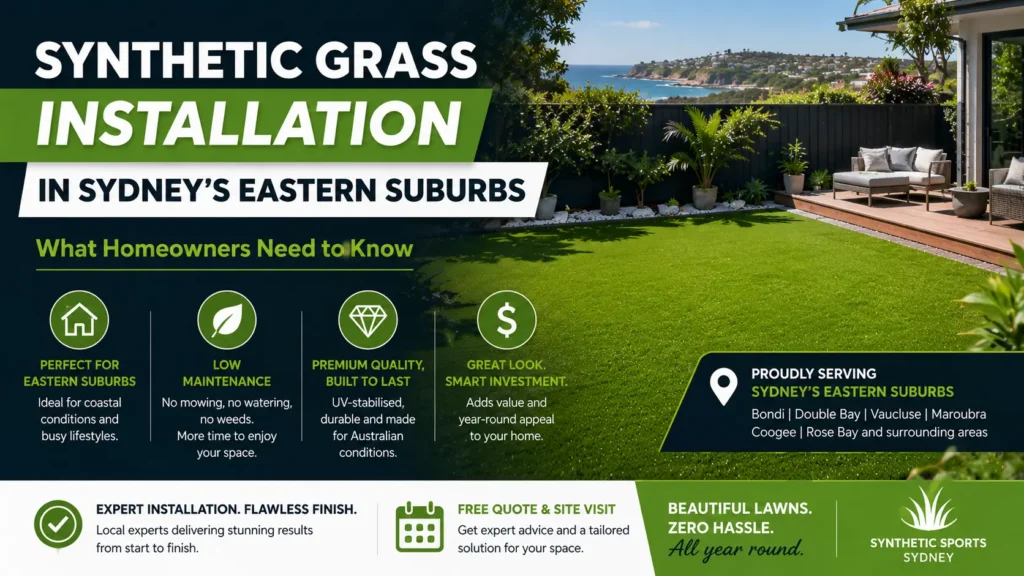
Coastal salt air, sandy soil, and compact lots make the Eastern Suburbs one of Sydney’s most demanding environments for synthetic grass, and one of the most rewarding when the installation is done right.
Synthetic grass installation in Sydney’s Eastern Suburbs requires homeowners in Maroubra, Randwick, Coogee, and Bondi to address 4 location-specific challenges that standard suburban installations never encounter: salt air fibre degradation, sandy soil base instability, tight lot dimensions inherited from federation-era subdivision, and Randwick Council approval requirements for certain property types.
The guide gives Eastern Suburbs homeowners a complete, location-specific guide to synthetic grass installation decisions, product selection, and council compliance.
Why Coastal Properties in the Eastern Suburbs Need Tougher Turf
Coastal properties in Sydney’s Eastern Suburbs need tougher synthetic grass specifications because salt air, ocean wind, and high UV exposure create a 3-factor degradation environment that standard residential turf products are not engineered to withstand.
1 – Salt Air Fibre Degradation
Properties within 500 metres of the Eastern Suburbs coastline, including beachfront and near-beach homes in Bondi, Coogee, Maroubra, and Bronte, receive continuous salt air exposure that accelerates polymer breakdown in synthetic grass fibres not manufactured with marine-grade UV and salt resistance. Standard synthetic grass fibres exposed to coastal salt air without marine-grade stabilisation lose tensile strength 40–50% faster than equivalent products in non-coastal Sydney suburbs, resulting in fibre brittleness and colour fading within 3–5 years rather than the expected 10+ year lifespan.
2 – Elevated UV Exposure
Eastern Suburbs properties receive UV radiation reflected from both direct sunlight and ocean surface reflection, a dual-source UV loading that increases effective fibre exposure beyond standard Sydney suburban UV levels. Synthetic grass products installed in coastal Eastern Suburbs locations require UV stabilisation ratings verified for Australian coastal conditions, not standard inland residential specifications.
3 – Ocean Wind Loading
Consistent ocean winds from the east and south-east create physical stress on synthetic grass edges, joins, and perimeter securing in Eastern Suburbs installations. Perimeter fixing in coastal Eastern Suburbs installations requires galvanised nails or stainless steel securing pins at 150mm intervals, compared to the 200–250mm standard spacing used in non-coastal Sydney installations, to prevent edge lifting under sustained wind loading.
| Property Zone | Distance From Coast | Key Risk | Required Specification |
| Beachfront | 0–100m | Maximum salt + UV + wind | Marine-grade fibre + stainless fixings |
| Near-Beach | 100–500m | High salt + elevated UV | Coastal-rated UV stabilisation |
| Suburban Coastal | 500m–2km | Moderate salt exposure | Standard AU-made + UV verified |
| Inland Eastern Suburbs | 2km+ | Standard UV only | Standard Australian-made product |
Sandy Soil Preparation for Eastern Suburbs Synthetic Grass Installations
Sandy soil preparation for Eastern Suburbs synthetic grass installations requires a fundamentally different base construction approach than clay or loam soil installations because sandy soil provides 3 specific base challenges: insufficient compaction stability, rapid moisture drainage without retention control, and surface level inconsistency under load.
The Sandy Soil Problem
Sandy soil is the dominant soil type across Maroubra, Randwick, Coogee, and Bondi residential lots. Sandy soil compacts poorly under standard aggregate base preparation methods. A synthetic grass installation placed over inadequately prepared sandy soil develops surface undulation within 12–18 months as the sandy sub-base shifts under foot traffic and rainfall infiltration.
Correct Base Construction for Sandy Eastern Suburbs Soil. Sandy soil preparation for Eastern Suburbs synthetic grass installations follows a 4-stage process:
Stage 1: Excavation to 100mm Minimum Depth
Sandy soil installations require excavation to a minimum depth of 100mm, compared to the 75mm standard for clay soil installations, to accommodate the additional base layer thickness needed to compensate for sandy soil’s lower natural compaction resistance.
Stage 2: Geotextile Fabric Installation
A geotextile separation fabric installed between the excavated sandy sub-base and the aggregate base layer prevents sand migration upward into the drainage aggregate over time. Geotextile fabric installation is non-negotiable in Eastern Suburbs sandy soil conditions; installations without it develop surface irregularities within 2–3 years as sand particles migrate through the aggregate layer.
Stage 3: Compacted Crushed Rock Base
A 75–100mm layer of 20mm crushed rock or decomposed granite is spread and compacted to 95% standard compaction across the full installation area. Crushed rock base provides the stable, interlocking particle structure that sandy soil alone cannot deliver.
Stage 4: Bedding Sand Layer and Final Grading
A 10–15mm bedding sand layer, screeded to a precise fall of 1:100 toward drainage points, creates the smooth, level surface that synthetic grass requires for consistent fibre presentation and water management across the completed installation.
Popular Turf Choices for Bondi, Coogee, and Maroubra Homes
Popular synthetic grass choices for Bondi, Coogee, and Maroubra homes share 3 common product attributes that Eastern Suburbs homeowners consistently prioritise: natural appearance at close range, coastal durability, and heat management performance during Sydney summer.
1 – Pile Height Selection for Eastern Suburbs Residential Use
Eastern Suburbs homeowners predominantly select synthetic grass in the 30–35mm pile height range. A specification that balances natural lawn appearance with practical maintenance requirements in coastal conditions. Pile heights below 25mm appear visually sparse against the lush garden aesthetic common in Eastern Suburbs properties. Pile heights above 40mm retain more salt and dust particles in coastal environments, requiring more frequent rinsing to maintain appearance.
2 – Colour and Texture Preferences
Eastern Suburbs homeowners select synthetic grass products combining 2–3 colour tones, a blend of mid-green, olive, and light green fibres, that replicate the natural variation of a healthy kikuyu or buffalo lawn. Single-colour synthetic grass products appear visually artificial at the close viewing distances common in compact Eastern Suburbs lots, where outdoor spaces are observed from indoor living areas at 3–8 metre proximity.
3 – Coastal-Rated Product Specifications
Greenscapes Turfing recommends Australian-made synthetic grass products for all Eastern Suburbs installations, specifying products that carry documented UV stabilisation test results for coastal Australian conditions and fibre composition free of salt-sensitive polymer compounds. These products maintain colour stability, fibre resilience, and surface texture for 10+ years in Bondi, Coogee, and Maroubra’s coastal environment.
Council Approval: Is It Needed for Synthetic Grass in the Eastern Suburbs LGA?
Council approval requirements for synthetic grass installation in the Eastern Suburbs LGA depend on 3 property-specific factors that Randwick Council. The primary local government authority covering Maroubra, Coogee, Randwick, and surrounding suburbs assesses on a case-by-case basis.
Randwick Council is the local government authority governing development and property modification across the Eastern Suburbs LGA, operating under the Environmental Planning and Assessment Act 1979 (NSW). Non-compliance with Randwick Council’s development controls for surface modifications risks stop-work orders, mandatory removal of installed materials, and reinstatement costs at the property owner’s expense. When planning a synthetic grass installation in the Eastern Suburbs, confirm approval requirements with Randwick Council directly before works commence.
The following are the 3 factors that determine whether council approval is required:
1: Heritage Conservation Area Status
Properties located within Randwick Council’s designated heritage conservation areas, including parts of Coogee, Randwick, and Maroubra, require a development application for front garden surface modifications visible from the street. Rear garden installations on heritage-listed properties generally proceed as exempt development, but front-of-property installations require individual assessment.
Factor 2: Stormwater and Drainage Impact
Randwick Council’s development controls require that surface modifications maintain equivalent or improved stormwater drainage performance compared to the existing surface. Synthetic grass installations with correctly specified drainage base layers typically satisfy Randwick Council’s stormwater neutrality requirement without formal DA approval, as permeable synthetic grass outperforms concrete and paving on drainage performance measures.
Factor 3: Strata and Apartment Common Areas
Eastern Suburbs properties in strata schemes, a significant proportion of Bondi, Coogee, and Randwick’s residential stock, require strata committee approval before any common area surface modification, including courtyard and rooftop synthetic grass installations. Individual lot courtyard installations within a strata property require both strata approval and confirmation of Randwick Council’s exempt development status before proceeding.
What Eastern Suburbs Homeowners Should Confirm Before Installation Day
Eastern Suburbs synthetic grass installations succeed when homeowners verify 4 factors before works commence: coastal-rated product certification, sandy soil base construction specification, council approval status for their specific property type, and installer experience with local conditions.
1- Product Certification
Confirm that the synthetic grass product specified for your installation carries documented UV stabilisation test results for Australian coastal conditions and lead-free fibre certification. Request these documents in writing before approving any quote.
2 – Base Construction Specification
Confirm that the installation quote includes geotextile fabric installation, a minimum 75–100mm compacted crushed rock base, and a screeded bedding layer graded to a 1:100 drainage fall. Base construction specification should appear as a line item in every Eastern Suburbs installation quote. Not as a generic “ground preparation” description.
3 – Council Approval Status
Confirm your property’s heritage conservation area status and strata scheme requirements with Randwick Council before installation day. A 10-minute council enquiry prevents the cost and disruption of a stop-work order after installation has commenced.
4 – Installer Local Experience
Confirm that your installer has completed projects in Eastern Suburbs conditions, specifically sandy soil, coastal exposure, and compact lot dimensions, which require hands-on local experience that general Sydney installers do not possess.
Synthetic grass installation in Sydney’s Eastern Suburbs delivers lasting results when the right product, base preparation, and local expertise come together. Contact Greenscapes Turfing today for a free measure and quote — an Eastern Suburbs team that knows coastal installations from the ground up.