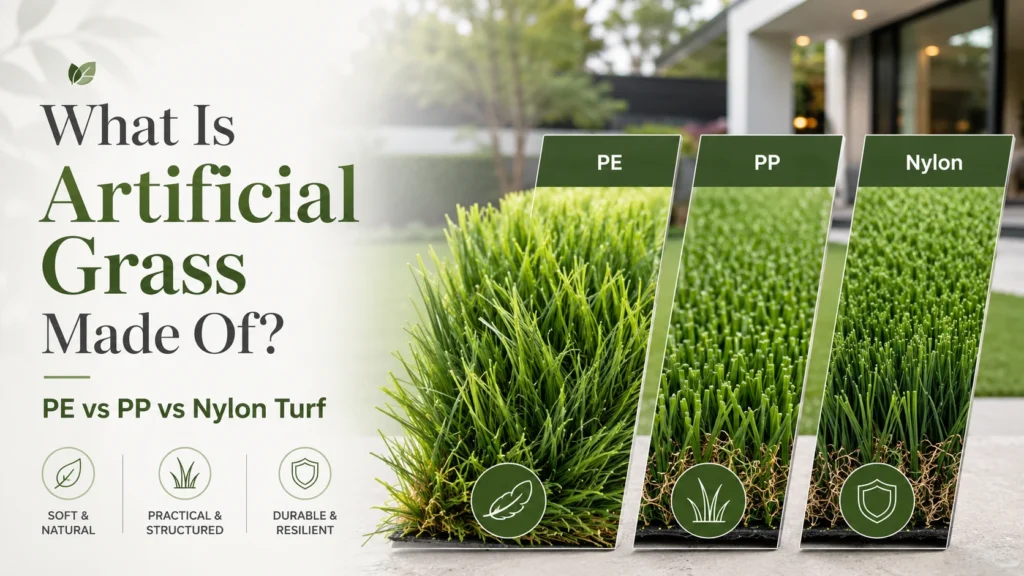
Artificial grass is mainly made from synthetic polymer fibres, most commonly polyethylene, polypropylene or nylon. When homeowners ask what is artificial grass made of, however, the grass blades are only part of the answer.
These three polymers behave differently.
- Polyethylene (PE) is widely used for realistic landscape lawns
- Polypropylene (PP) commonly appears in specialist fibres, thatch and backing components
- Nylon provides high resilience for more demanding applications.
A complete synthetic turf system also includes backing, supporting thatch, coatings, UV stabilisers and, in many installations, infill. Understanding each component makes it easier to select turf for a Sydney lawn, pet area, putting green or sports surface.
What Is Artificial Grass Actually Made Of?
Artificial turf is a manufactured surface consisting of several layers and materials working together.
Grass Fibres
The visible blades are normally manufactured from:
- Polyethylene
- Polypropylene
- Nylon
For anyone asking what artificial grass blades are made of, these three polymers account for the main fibre materials used across landscape and specialist synthetic turf systems.
Thatch
Thatch consists of shorter, often curled fibres positioned around the base of the main blades. It adds visual density and helps support the taller yarns.
Primary Backing
The primary backing is the woven structural layer into which the synthetic yarns are tufted.
Secondary Backing or Coating
A secondary coating helps secure those tufts and stabilise the finished turf structure.
Infill
Infill is introduced during many installations to provide ballast, support the fibres, or achieve application-specific performance.
Artificial grass is therefore more than simply “plastic grass”. Its performance depends on how all these components interact.
Image suggestion: Add a cross-sectional diagram identifying grass fibres, thatch, primary backing, secondary coating and infill.
PE vs PP vs Nylon Artificial Grass at a Glance
No single polymer performs best in every application.
| Material | Feel | Realism | Resilience | Moisture Behaviour | Typical Uses |
| Polyethylene (PE) | Soft | High | Good | Low absorption | Lawns, pets, landscaping, some sport |
| Polypropylene (PP) | Flexible/fine | Application dependent | Lower than nylon | Low absorption | Putting, thatch, backing, specialist turf |
| Nylon | Firmer/stiffer | Application dependent | Very high | Higher than PE | High-wear, specialist and demanding surfaces |
The correct material depends on comfort, expected traffic, moisture exposure, desired appearance, sporting requirements and the construction of the complete turf.
This is why comparing artificial grass materials only by polymer name can be misleading.
Polyethylene Artificial Grass: The Common Choice for Lawns
Polyethylene artificial grass is widely used for modern residential landscape turf because it combines softness, flexibility, natural movement and useful durability.
Its relatively low moisture absorption also makes PE suitable for outdoor environments.
Common applications include:
- Residential lawns
- Family backyards
- Pet areas
- Landscape projects
- Some sporting surfaces
Manufacturers can form polyethylene yarn into different blade shapes, thicknesses and profiles. They can also vary pile height, density and supporting thatch to produce surfaces with very different characteristics.
That means PE itself is not a quality rating.
A sparse PE lawn with weak fibre recovery does not become a strong product simply because polyethylene was used. Product construction still matters.
You can also read how artificial grass pile height affects performance when comparing different PE landscape products.
Polypropylene Artificial Grass: Where Does PP Work Best?
Polypropylene artificial grass is often misunderstood because polypropylene is sometimes described simply as the lower-quality turf material. That description is too broad.
PP is lightweight, flexible, and has low moisture absorption. Those properties make it useful in several parts of synthetic turf construction.
Depending on the product, polypropylene can appear in:
- Specialist putting surfaces
- Texturised fibres
- Curled thatch
- Primary backing
- Other specialist turf systems
PP generally offers lower fibre resilience than nylon, so its suitability for longer-pile or highly trafficked applications depends heavily on product design.
That does not make polypropylene inherently poor.
In a PE vs PP artificial grass comparison, polyethylene is more suitable for realistic residential blades, while polypropylene can be highly suitable for supporting fibres or specialist surfaces.
The application determines whether the material makes sense.
Nylon Artificial Grass: Strong and Resilient but More Specialised
Nylon artificial grass is known for strong fibre recovery, high abrasion resistance and excellent resilience under demanding use.
It also generally provides greater heat resistance than PE or PP, which can be useful in specialist applications.
Those strengths come with different characteristics. Nylon tends to feel firmer than polyethylene and absorbs more moisture than PE, so maximum resilience does not automatically make it the preferred residential lawn material.
Nylon can be used in applications such as:
- Specialist putting surfaces
- Commercial areas
- High-wear installations
- Certain sports systems
- Secondary fibres in engineered turf products
Strength is only one turf attribute.
A homeowner wanting a soft, natural-looking lawn may value polyethylene’s flexibility more than nylon’s additional rigidity, while a specialist surface may prioritise fibre recovery.
PE vs Nylon Artificial Grass: Which Is Better for a Lawn?
For a conventional residential landscape lawn, polyethylene is usually the more suitable option because softness, realistic movement and low moisture absorption matter more than maximum fibre rigidity.
The PE vs nylon artificial grass comparison changes when the installation has unusual performance requirements.
Nylon can make more sense where:
- Fibre recovery is a major priority
- Traffic is particularly demanding
- Higher heat resistance is relevant
- The surface serves a specialist function
The nylon vs polyethylene artificial grass decision therefore depends on what the turf needs to do.
For most Sydney family lawns, PE provides a practical combination of comfort and durability. Specialist environments can justify nylon where additional resilience offers a meaningful advantage.
The best material depends on the application, not which polymer is technically strongest.
Is Polyethylene or Polypropylene Better for Artificial Grass?
For general residential landscape blades, polyethylene typically provides the better balance of softness, strength and natural appearance.
Polypropylene can be better suited to other parts of a synthetic turf system, including curled thatch, backing components and certain specialist putting surfaces.
This makes polyethylene vs polypropylene artificial grass less of a simple “better versus worse” comparison.
Two products using the same polymer can still behave differently because manufacturers can change:
- Fibre shape
- Yarn quantity
- Density
- Pile height
- Stitch rate
- Supporting thatch
- Backing construction
For anyone asking what is the best artificial grass material, the correct answer depends on how those materials are engineered into the complete product and where that product is installed.
What Material Is Artificial Grass Backing Made From?
Artificial grass backing is structurally separate from the visible blades.
A typical turf product has a woven primary backing that holds the tufted yarn, followed by a secondary coating that helps secure the fibres and maintain dimensional stability.
Polypropylene is commonly used within primary backing construction. Depending on product design, secondary coatings can incorporate materials such as latex or polyurethane-type compounds.
For anyone asking what artificial grass backing is made of, there is no single universal composition across all products.
The backing needs to:
- Hold fibres securely
- Maintain turf dimensions
- Support installation
- Work with the drainage design
Backing chemistry alone does not prove quality. Its construction, stability, tuft retention and compatibility with the wider turf system matter more than simply seeing one particular material on a specification sheet.
Do Turf Materials Matter in Australian Conditions?
Yes, but the base polymer is only part of the Australian performance equation.
Synthetic grass installed outdoors in Sydney is exposed to strong UV radiation, heat, rainfall and repeated everyday use. Manufacturers can incorporate UV stabilisers and other additives into yarn systems to improve resistance to outdoor degradation.
Australian buyers should therefore ask:
- Is the turf UV stabilised?
- What outdoor conditions was it designed for?
- What does the warranty cover?
- Is it suited to the intended application?
Products marketed as UV-stabilised artificial grass Australia options need to be assessed through documented product specifications rather than the polymer name alone.
Greenscape uses Australian-made, UV-stable turf selected for Sydney conditions. Manufacturing origin provides useful context, but UV performance, construction, quality control and warranty remain the stronger indicators of suitability.
Material Alone Does Not Determine Artificial Grass Quality
PE is not automatically premium. PP is not automatically cheap. Nylon is not automatically best.
Overall turf quality also depends on fibre thickness, yarn construction, density, stitch rate, pile height, thatch, backing, UV stabilisation, drainage and installation.
For example, a dense PE landscape surface using resilient fibres and appropriate UV protection can outperform a poorly engineered product manufactured from a theoretically stronger polymer.
The material name tells you what the yarn is made from. It does not tell you how well the entire turf has been designed.
Homeowners comparing products can use our guide on how to tell good artificial grass from cheap turf to inspect fibre recovery, backing, density and other construction characteristics before choosing.
Which Artificial Grass Material Should You Choose?
Choose the complete turf system according to its intended use rather than selecting a polymer in isolation.
Residential Lawn
PE-based landscape turf is commonly suitable because it provides softness, natural movement and good durability.
Pet Area
PE often works well because of its low moisture absorption, but drainage, infill, cleanability and installation design remain important. Anyone asking which artificial grass material is best for pets should therefore compare the complete pet-turf system rather than just the blade polymer.
Putting Green
PP or nylon can be used depending on required ball speed, fibre structure and overall surface design. Purpose-built synthetic putting green products are engineered differently from standard landscape lawns.
Sports Surface
Material choice depends on the sport, expected traffic and required surface characteristics.
Commercial or High-Wear Area
Resilience, traffic level, backing stability and installation requirements all need to be assessed together.
You can compare synthetic grass options across Greenscape’s current range when considering which construction suits your project.
Conclusion
Artificial grass is mainly manufactured using polyethylene, polypropylene or nylon fibres, supported by backing, thatch, coatings and other components.
PE provides softness and realistic movement. PP is useful across specialist fibres, thatch and backing applications. Nylon provides particularly strong fibre resilience.
None of these materials determines turf quality by itself.
Density, pile height, yarn construction, backing, UV stability, drainage and synthetic grass installation in Sydney all contribute to the finished surface.
Greenscape Turfing can help you compare complete turf systems according to how your Sydney lawn, pet area, putting green or other outdoor space will actually be used.
FAQs
What is artificial grass made from?
Artificial grass is primarily made from synthetic polymer fibres such as polyethylene, polypropylene and nylon. The complete product can also contain supporting thatch, woven backing, secondary coatings and infill, depending on its design and intended application.
Is polyethylene good for artificial grass?
Yes. Polyethylene is widely used for residential landscape turf because it combines softness, flexibility, realistic movement and useful durability. Its performance still depends on factors such as fibre construction, density, backing and UV stabilisation.
Is polypropylene artificial grass good?
Polypropylene can be highly suitable for particular turf applications, including thatch, backing and specialist surfaces. It generally offers lower resilience than nylon, but that does not make PP inherently low quality. Suitability depends on how the material is used within the turf system.
Is nylon or polyethylene better for artificial grass?
Polyethylene is generally better suited to conventional residential lawns where softness and realism matter. Nylon offers greater resilience and can suit high-wear or specialist applications. Neither material is universally better because they solve different performance requirements.
Which artificial grass material looks most natural?
Polyethylene is commonly used for realistic landscape turf because its softness and flexibility allow natural-looking blade movement. Appearance also depends on fibre shape, colour variation, supporting thatch, density and pile height rather than polymer type alone.
What material is artificial grass backing made from?
Primary turf backing commonly incorporates woven polypropylene, while secondary backing or coatings can use materials such as latex or polyurethane-type compounds. Construction varies between products, so backing stability and tuft retention are more important than assuming one chemistry is always superior.
Which turf material is best for pets?
Polyethylene commonly suits pet areas because it combines softness, durability and low moisture absorption. Drainage, infill selection, fibre density and cleaning requirements are also important, so pet suitability cannot be determined from fibre material alone.
Which material is used for putting green turf?
Putting green systems can use polypropylene, nylon or other engineered fibre combinations depending on required ball speed, surface firmness and product design. Putting turf should be selected by playing characteristics rather than applying residential lawn specifications to a specialist sporting surface.