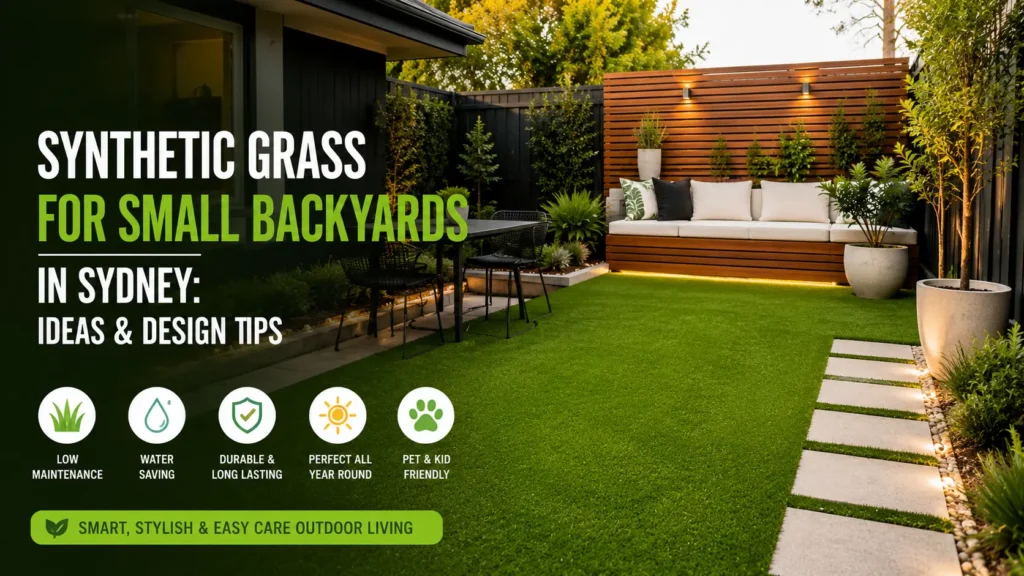
Even the smallest backyard in Sydney can become the most beautiful one when synthetic grass replaces its patchy and unmanageable lawn.
At the same time, small backyard design in Sydney presents 3 core challenges for homeowners in Maroubra, Ryde, and the Eastern Suburbs. Those 3 core challenges are listed below:
- Compact block sizes averaging 200–400m²
- Irregular lot shapes inherited from older subdivision patterns
- The near-impossibility of maintaining natural grass in shaded or high-traffic confined spaces
Synthetic grass solves all 3 challenges simultaneously while delivering a low-maintenance, year-round green surface that makes compact outdoor areas feel intentional and liveable. The following 5 design and planning tips cover everything Sydney homeowners need to know before transforming their small backyard.
Design Ideas: Pavers and Turf Combinations for Small Sydney Lots
Pavers and turf combinations for small Sydney lots create visual interest, defined zones, and practical surfaces within compact outdoor footprints by dividing the backyard into 2 or more distinct functional areas.
The Paver Pathway Through Turf Installing a 400–600mm wide paver pathway through a central turf area creates a structured walking route that protects synthetic grass fibres from concentrated foot traffic while visually lengthening the backyard. Bluestone, sandstone, and concrete pavers all complement green synthetic turf effectively in Sydney’s coastal and suburban aesthetic contexts.
The Turf Border Around a Paved Entertainment Zone. A central paved entertainment area of 10–15m² surrounded by a synthetic grass border of 500–800mm width transforms a featureless small backyard into a purposeful outdoor room. This layout separates the entertaining surface from the green space, giving both zones a defined role without consuming additional square metres.
The Diagonal Turf Layout: Installing synthetic grass at a 45-degree angle to the fence line is the single most effective optical technique for making a small backyard appear wider. Diagonal turf lines draw the eye toward the corners of the space rather than straight across the shortest dimension, adding a perceived 20–30% increase in visual width.
Raised Garden Bed and Turf Integration Timber or Corten steel raised garden beds positioned along 1 or 2 fence lines with synthetic grass filling the remaining ground area creates layered vertical interest in small backyards. Garden beds elevated 300–450mm above turf level introduce planting space without consuming ground-level square metres that synthetic grass occupies more effectively.
| Design Combination | Best For | Visual Effect |
| Paver Pathway + Turf | Narrow long lots | Lengthens space |
| Central Paving + Turf Border | Square compact lots | Creates an outdoor room feel |
| Diagonal Turf Layout | Any small lot shape | Widens perceived space |
| Raised Beds + Turf | Fence-line gardens | Adds vertical depth |
| Full Turf + Step Pavers | Minimal budget lots | Maximises green space |
Why Small Backyards Benefit Most From Synthetic Grass
Small backyards benefit most from synthetic grass installation because confined spaces amplify every lawn maintenance problem, including dead patches, mowing difficulty, and soil compaction, that natural grass produces.
No More Dead Patches Natural grass in small Sydney backyards dies in 3 predictable zones: shaded corners receiving less than 4 hours of direct sunlight daily, high-traffic pathways where foot pressure compacts soil within 6–8 weeks, and narrow strips under 1 metre wide where mower access is physically impossible. Synthetic grass maintains uniform green colour and texture across all 3 zones regardless of sunlight exposure, foot traffic frequency, or strip width.
No Mowing Awkwardness Mowing a small backyard with a standard lawn mower requires 4–6 directional changes per pass in spaces under 30m², creating uneven cut patterns and missed edges along fences and garden beds. Synthetic grass eliminates mowing, replacing a weekly 45-minute maintenance task with a monthly 15-minute brush and rinse routine.
Year-Round Usability Small backyard spaces in Sydney sit unused for 3–4 months annually when natural grass turns brown, muddy, or waterlogged during winter rainfall. Synthetic grass remains usable, clean, and visually appealing across all 12 months, converting previously wasted outdoor square metres into functional living space year-round.
How to Visually Expand a Small Backyard With Turf Layout
Visually expanding a small backyard with turf layout requires applying 4 spatial design principles that manipulate perceived depth, width, and boundary definition within compact outdoor areas.
Principle 1: Extend Turf to Every Boundary. Synthetic grass installation that runs wall-to-wall, fence-to-fence, without interruption, creates a seamless green plane that removes visual boundaries. Uninterrupted turf surfaces make small backyards appear 25–35% larger than equivalent spaces broken up by multiple materials and borders.
Principle 2: Use Curved Turf Edges Instead of Straight Lines. Curved synthetic grass edges along garden beds and paved zones introduce organic shapes that slow the eye’s movement across the space, creating an impression of greater area. Straight-edged rectangular turf installations in small yards emphasise boundary proximity and make compact spaces feel more confined.
Principle 3: Match Turf Pile Direction to the Longest Dimension. Synthetic grass fibres have a natural lean direction determined during installation. Aligning fibre direction along the longest dimension of the backyard, typically depth from the house to the rear fence, creates a visual runway effect that emphasises length over width.
Principle 4: Eliminate Level Changes Where Possible. Flat, continuous synthetic grass surfaces at a single level across the entire backyard remove the visual interruption of steps, raised sections, and retaining edges. Level changes in small spaces fragment the eye’s path and reinforce the perception of limited square metres.
Real Sydney Small Backyard Project Examples
Real Sydney small backyard transformations by Greenscapes Turfing demonstrate consistent results across 3 common lot types in Maroubra, Ryde, and Eastern Suburbs properties.
Maroubra Terrace Backyard (18m²). A narrow 18m² terrace backyard in Maroubra replaced bare dirt and broken concrete with a full synthetic grass installation plus 2 sandstone step pavers. The result delivered a clean, child-safe play surface that the family uses year-round without any lawn maintenance requirements.
Ryde Semi-Detached (35m²). A 35m² semi-detached backyard in Ryde combined a 12m² central paved entertainment zone with synthetic grass borders on 3 sides. The diagonal turf installation on the side return added perceived width to a long, narrow lot shape that previously felt like a corridor.
Eastern Suburbs Courtyard (22m²) A 22m² Eastern Suburbs courtyard replaced existing timber decking, which had deteriorated after 6 years of Sydney coastal humidity, with a full synthetic grass installation. Surface temperature measurements confirmed a 15–18°C reduction compared to the previous decking surface during summer afternoons.
See how Greenscapes Turfing has transformed small Sydney backyards across these suburbs and more. Contact us and get your free quote today.
What to Ask Your Turf Installer About Small-Yard Installations
Small-yard synthetic grass installations require 5 specific questions that homeowners must ask every turf installer before committing to a quote or product selection.
1. What base preparation does this space require?
Small backyards frequently contain compacted clay soil, old concrete sub-bases, or drainage problems invisible at the surface level. Base preparation, including excavation depth, compaction material type, and drainage layer specification, determines whether synthetic grass performs correctly for 10+ years or begins lifting and pooling water within 2–3 years.
2. What pile height suits this space and its use?
Synthetic grass pile heights range from 20mm to 40mm across residential products. A 25–30mm pile height suits most small Sydney backyards, balancing natural appearance with durability under foot traffic. Pile heights above 35mm require more frequent brushing in high-use small spaces.
3. Is this product Australian-made and UV-stabilised?
Australian-made synthetic grass products contain UV stabilisation compounds engineered for Australian solar radiation levels, significantly more intense than European or North American products. Non-UV-stabilised products begin colour degradation and fibre brittleness within 3–4 years under Sydney’s high UV index conditions.
4. What warranty covers both product and installation?
Product warranty and installation warranty are 2 separate guarantees that both require confirmation. Greenscapes Turfing provides a 10-year warranty covering both the Australian-made product and the professional installation, giving small backyard homeowners complete protection on their investment.
5. Can you show me completed small-yard projects similar to mine?
Completed project examples in comparable Sydney lot sizes and shapes provide the most reliable indicator of an installer’s capability and finish quality in confined spaces. Request photographic evidence of at least 3 completed small-yard installations before approving any quote.
Transform Your Small Sydney Backyard With Greenscapes Turfing
Small Sydney backyards deliver their full potential when synthetic grass replaces the 3 chronic problems of natural lawn, including dead patches, mowing difficulty, and seasonal unusability, with a single durable, beautiful, low-maintenance surface. Applying the 4 spatial design principles, selecting the right paver and turf combination, and asking the 5 essential installer questions ensures every square metre of compact outdoor space performs at its highest possible value.
Greenscapes Turfing supplies and installs premium Australian-made synthetic grass across Sydney’s smallest and most challenging backyard spaces. Contact us today for a free measure and quote, and see what your small backyard is truly capable of.