Bark chips compact, rubber crumbs overheat, and natural grass disappears when your children run and play over them regularly. At the same time, every Sydney parent checking a childcare centre asks the same unspoken question: what happens when my child falls while playing in the ground?
Therefore, Sydney playgrounds need a surface that actually holds up.
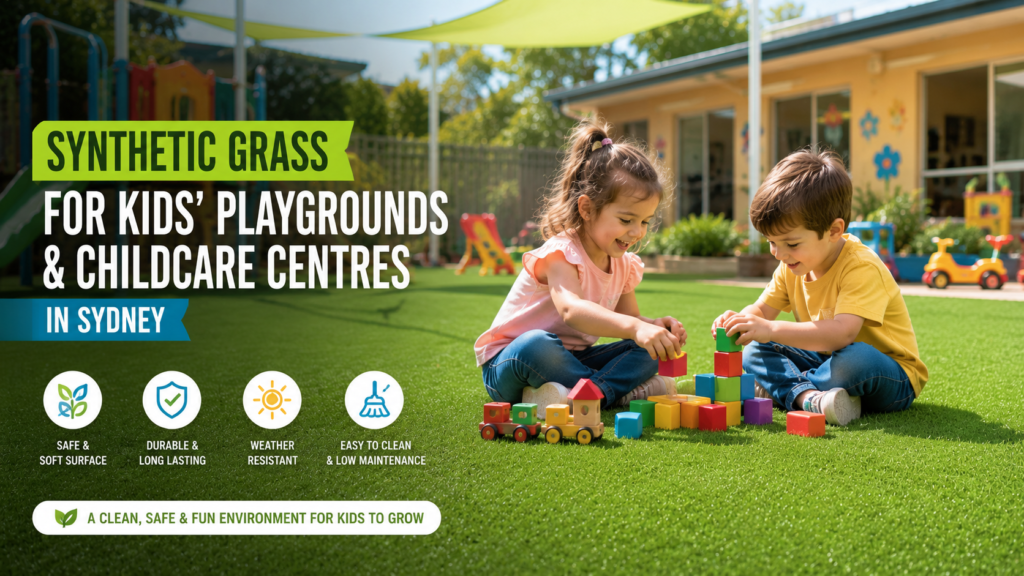
Synthetic grass for kids’ playgrounds and childcare centres in Sydney addresses 4 critical requirements that parents, childcare operators, and facility managers must satisfy simultaneously: Australian safety compliance, surface hygiene, allergen reduction, and year-round durability under intensive child use.
This guide covers every consideration Sydney childcare operators and parents need before selecting a playground surface. From compliance standards to installation specifics.
Why Synthetic Grass Outperforms Bark Chips and Rubber Crumbs for Playgrounds
Synthetic grass outperforms bark chips and rubber crumbs for playground surfaces across 4 measurable performance categories: hygiene maintenance, allergen exposure, consistency of fall protection, and long-term cost efficiency.
1 – Hygiene Maintenance
Synthetic grass fibres repel moisture at the surface level and rinse clean within minutes, eliminating the bacterial colonies and fungal growth that bark and rubber surfaces develop under Sydney’s humid conditions.
2 – Allergen Exposure
Synthetic grass contains no organic material, producing zero pollen, zero mould spores, and zero bark dust, reducing allergen exposure for children with respiratory sensitivities by removing 3 common playground allergen sources entirely.
3 – Consistency of Fall Protection
Synthetic grass maintains uniform cushioning depth across the entire play surface for 10+ years without compaction, unlike bark chips that lose protective depth within 6–8 weeks of installation under regular foot traffic.
4 – Long-Term Cost Efficiency
Synthetic grass eliminates the recurring top-up costs that bark chips require every 6–12 months, delivering a fixed installation investment with no scheduled material replacement over a 10-year product lifespan.
Each of these 4 advantages becomes clearer when compared directly against the 2 surfaces Sydney playgrounds most commonly use as alternatives.
Bark Chips:
3 Critical Limitations
Bark chips present 3 specific problems in Sydney playground environments. First, bark chip surfaces compact unevenly under repeated foot traffic, reducing fall protection depth from the required 300mm to as little as 80–100mm within 6–8 weeks of installation. Second, bark chips harbour moisture beneath the surface layer, creating fungal growth and bacterial colonies that present direct hygiene risks to children who contact the ground. Third, bark chips attract insects (including spiders and ants) at rates incompatible with childcare centre hygiene standards.
Rubber Crumbs:
Safety Concerns Under Australian Conditions
Rubber crumb surfaces reach surface temperatures of 60–70°C under direct Sydney summer sun, creating burn risk for children making skin contact during outdoor play. Rubber crumb products manufactured before 2010 contain detectable levels of polycyclic aromatic hydrocarbons (PAHs), chemical compounds classified as harmful to children with prolonged skin exposure. Rubber crumb surfaces also degrade under UV exposure, releasing fine particulate matter that children inhale during ground-level play.
Synthetic Grass:
The Performance Standard
Synthetic grass delivers consistent, measurable fall protection depth across the entire playground surface without compaction, harbours no moisture at the fibre level when installed with correct drainage, and maintains surface hygiene through simple water rinsing. Child-safe synthetic grass products contain no lead, no PAHs, and no harmful VOC compounds, satisfying Australian childcare facility requirements across all Sydney councils.
| Surface Type | Fall Protection Consistency | Hygiene Risk | Summer Heat Risk | Allergen Level |
| Synthetic Grass | Consistent across the full surface | Low | Low–Medium | Minimal |
| Bark Chips | Degrades within 6–8 weeks | High (fungal, bacterial) | Low | High (mould spores) |
| Rubber Crumbs | Consistent but heat-affected | Medium | Very High | Medium (PAHs) |
| Natural Grass | Inconsistent (bare patches) | Medium | Low | High (pollen) |
Australian Safety Standards for Playground Surfaces: AS/NZS 4422:1996
Australian safety standards for playground surfaces require compliance with AS/NZS 4422:1996, the national standard governing impact-absorbing playground surfaces across all public, commercial, and childcare facility installations in Sydney and New South Wales.
AS/NZS 4422:1996 is the joint Australian and New Zealand standard that specifies critical fall height (CFH) requirements for playground surfacing materials. Critical fall height defines the maximum equipment height from which a child can fall onto a compliant surface without sustaining a life-threatening head injury.
Non-compliance with AS/NZS 4422:1996 exposes childcare operators to direct liability under the Work Health and Safety Act 2011 (NSW) and risks facility licence suspension by the NSW Department of Education.
Select only synthetic grass products that carry documented AS/NZS 4422:1996 test certification, confirming the specific critical fall height the product satisfies at its installed depth and infill specification.
The following are the 3 key compliance requirements Sydney childcare operators must verify before approving any playground surface installation:
1. Critical Fall Height Rating
Synthetic grass systems for playground use must achieve a minimum critical fall height rating matching the tallest play equipment in the facility. Equipment heights of 600mm–1,500mm require CFH-rated surfacing verified by accredited laboratory testing.
2. HIC (Head Injury Criterion) Score
AS/NZS 4422:1996 requires playground surfaces to achieve an HIC score below 1,000 at the specified critical fall height. Compliant synthetic grass systems with appropriate cushioning underlay consistently achieve HIC scores between 400–700, well within the safety threshold for standard childcare equipment heights.
3. Surface Drainage Performance
Compliant playground surfaces must drain at a minimum rate of 10 litres per square metre per minute to prevent waterlogging that reduces fall protection performance. Synthetic grass installed over a correctly specified aggregate base and drainage layer achieves drainage rates of 15–30 litres per square metre per minute.
What to Look for in Child-Safe Synthetic Turf for Playgrounds
Child-safe synthetic turf for playgrounds requires verification across 5 specific product attributes that distinguish compliant, safe installations from standard residential or commercial turf products.
1. Lead-Free Fibre Certification
Synthetic grass fibres manufactured before 2010 in certain overseas markets contained lead-based UV stabilisers. Child-safe synthetic grass must carry documented lead-free certification confirming fibre composition testing by an accredited laboratory. Australian-made synthetic grass products manufactured to current standards contain zero lead compounds.
2. UV Stabilisation for Australian Solar Conditions
Playground synthetic grass in Sydney receives UV Index 11–13 radiation during the summer months, the extreme classification on the Australian UV Index scale. UV-stabilised fibres maintain structural integrity and colour stability for 10+ years under these conditions. Non-UV-stabilised products begin fibre degradation within 3–4 years, releasing fine particles at ground level where children play.
3. Soft Infill Specification
Standard silica sand infill used in residential synthetic grass installations presents an abrasion risk to children falling or sliding across the surface. Child-safe playground turf requires either rounded silica sand, cork infill, or TPE (thermoplastic elastomer) infill, 3 softer alternatives that reduce skin abrasion and maintain surface cushioning under repeated impact.
4. Antimicrobial Treatment
Childcare-grade synthetic grass products incorporate antimicrobial fibre treatments that inhibit bacterial and mould growth at the surface level. Antimicrobial treatment is particularly critical in Sydney’s humid coastal climate, where untreated surfaces can develop hygiene issues within a single wet season.
5. Non-Toxic Backing Material
Synthetic grass backing, the rubber or polyurethane layer anchoring fibres to the base, must carry non-toxic certification confirming the absence of harmful plasticisers and adhesive compounds that children contact during ground-level play.
Childcare Centre Installation Considerations in Sydney
Childcare centre synthetic grass installations in Sydney require 6 planning considerations beyond standard residential installation that operators must address before works commence.
1 – Council Development Approval
Childcare centre outdoor space modifications in Sydney LGAs, including the City of Sydney, Inner West, Randwick, and Ryde councils, require development application (DA) approval or a Complying Development Certificate (CDC) before surface installation. Confirm approval requirements with your specific council before scheduling installation works.
2 – Drainage Engineering for High-Use Surfaces
Childcare outdoor areas sustain foot traffic from 15–80 children daily, significantly higher than residential backyard use. Drainage engineering for childcare synthetic grass installations must account for compaction loading 3–4 times greater than residential specifications, requiring deeper aggregate base layers of 75–100mm minimum compacted depth.
3 – Seamless Installation Around Fixed Equipment
Playground equipment, including climbing frames, swing sets, and sandpit surrounds, requires synthetic grass installation up to and beneath fixed structures with sealed, non-trip edges. Exposed seams or lifted edges around equipment bases present trip hazards that violate AS/NZS 4422:1996 surface continuity requirements.
4 – Shade Structure Interaction
Sydney childcare regulations under the National Quality Standard (NQS) require adequate sun protection for outdoor play areas. Synthetic grass installations beneath shade sails or permanent shade structures require a drainage design that accounts for redirected rainfall runoff patterns created by the shade structure geometry.
5 – Hygiene Maintenance Protocol
Childcare synthetic grass surfaces require a documented daily inspection and weekly rinse maintenance protocol that satisfies NSW childcare facility hygiene standards. Greenscapes Turfing provides every childcare client with a written maintenance protocol covering daily checks, weekly rinsing, monthly brushing, and annual deep-clean procedures.
6 – Staged Installation to Minimise Disruption
Childcare centres operating during installation require a staged works scheduling that maintains safe outdoor access for children throughout the process. Greenscapes Turfing coordinates childcare installations in 2–3 staged sections, ensuring a compliant, safe outdoor space remains available at every phase of the project.
Our Approach to Playground and Childcare Installations
Every Greenscapes playground and childcare installation follows a structured 6-step process designed to deliver a compliant, safe, and durable play surface.
Step 1: Site Assessment
Greenscapes Turfing evaluates every playground and childcare location comprehensively, assessing equipment heights, drainage conditions, soil type, and shade structure positions, to determine the most effective installation strategy for AS/NZS 4422:1996 compliance.
Step 2: Ground Preparation
The existing surface, whether bark chips, rubber crumbs, natural grass, or concrete, is fully removed, levelled, and compacted to establish a stable, correctly graded base that supports long-term drainage performance under high daily foot traffic.
Step 3: Base Layer Installation
A specific aggregate base layer is installed beneath the synthetic grass to provide engineered drainage capacity of 15–30 litres per square metre per minute and a structurally sound foundation that resists compaction under 15–80 children of daily use.
Step 4: Turf Installation
The certified, Australian-made synthetic grass is meticulously spread, trimmed, and fastened across the full play surface, including seamless integration around all fixed playground equipment, eliminating trip-hazard edges throughout the installation area.
Step 5: Infill Application
Child-safe infill, rounded silica sand, cork, or TPE, depending on facility requirements, is applied evenly across the surface, providing the cushioning depth required to meet the facility’s critical fall height rating and keeping turf fibres upright under continuous use.
Step 6: Final Inspection and Handover
Greenscapes Turfing brushes, inspects, and tests the completed surface before handover, confirming surface consistency, seam integrity, drainage performance, and compliance with AS/NZS 4422:1996 across every square metre of the installation.
Greenscape Turfing backs every childcare and playground installation, covering both product performance and installation integrity.. Book a free consultation with Greenscapes Turfing today and give Sydney’s children the safest, most durable play surface available.